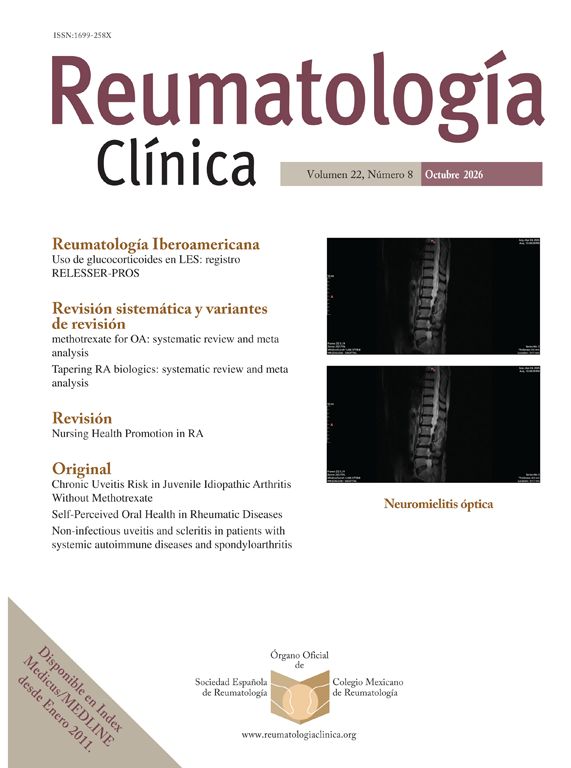
El trastorno del espectro de la neuromielitis óptica (NMOSD) asociado a la artritis reumatoide (AR) es una condición inflamatoria desmielinizante infrecuente, que representa un desafío diagnóstico.
Se presenta el caso de una mujer con AR de 10 años de evolución y paraparesia progresiva de 6 años. La resonancia magnética reveló mielitis transversa longitudinalmente extensa de T4 al filum terminal. El líquido cefalorraquídeo mostró bandas oligoclonales negativas e hiperproteinorraquia sin pleocitosis. El perfil inmunológico confirmó positividad para anticuerpos anti-acuaporina-4 (62 UI/ml), factor reumatoide y anti-CCP marcadamente elevados. Tras recibir metilprednisolona intravenosa, se obtuvo una recuperación motora parcial a 3/5. La paciente discontinuó voluntariamente el seguimiento médico, impidiendo iniciar la terapia inmunosupresora de mantenimiento.
La aparición de síntomas neurológicos atípicos en los pacientes con autoinmunidad sistémica exige una alta sospecha clínica de NMOSD, independientemente de la estabilidad de la artropatía basal. El diagnóstico temprano y la adherencia terapéutica estricta son cruciales para prevenir el daño estructural acumulativo y la discapacidad permanente.
Neuromyelitis optica spectrum disorder (NMOSD) associated with rheumatoid arthritis (RA) is an uncommon inflammatory demyelinating condition that presents a diagnostic challenge.
We report the case of a woman with a 10-year history of RA and a six-year progressive paraparesis. Magnetic resonance imaging revealed longitudinally extensive transverse myelitis from T4 to the filum terminale. Cerebrospinal fluid analysis showed negative oligoclonal bands and hyperproteinorachia without pleocytosis. The immunological profile confirmed positivity for anti-aquaporin-4 antibodies (62 UI/ml), along with markedly elevated rheumatoid factor and anti-CCP. Following intravenous methylprednisolone, a partial motor recovery to 3/5 was achieved. The patient voluntarily discontinued medical follow-up, preventing the initiation of maintenance immunosuppressive therapy.
The onset of atypical neurological symptoms in patients with systemic autoimmunity requires a high clinical suspicion of NMOSD, regardless of the stability of the underlying arthropathy. Early diagnosis and strict treatment adherence are critical to prevent cumulative structural damage and permanent disability.