
At present, there is a lack of treatments specifically designed to target knee osteoarthritis (KOA). Various intra-articular products have widespread and become commonplace in clinical practice, despite a scarcity of evidence supporting this procedure. Among these, SARC stands out as a novel Autologous Cytokine-Rich Serum derived from the patient's own platelets and white blood cells. This pilot study aims to assess the effectiveness of SARC treatment by measuring improvements in pain and physical disability in patients with symptomatic KOA.
MethodsWe recruited 40 symptomatic KOA patients with Kellgren–Lawrence stage 2 or 3, who had been refractory to glucocorticoid intra-articular treatment in the past year. They were assigned to two regimens (single vs. three-dose administrations), and were evaluated for their change in pain and physical function using the KOOS questionnaires at various time points over one year.
ResultsAt one year after treatment, 36% and 33% of patients achieved a 20% improvement in pain and functional disability, respectively. Patients treated with three intra-articular SARC injections showed a slightly higher improvement (40%) than the single-dose group (26–32%), although differences were not statistically significant. In average, both reversed KOOS scores showed significant improvements compared to baseline, especially for the three-dose group (14 and 16 points, respectively; p-values <0.0001). No adverse events were reported during the study.
ConclusionA notable proportion of patients with KOA refractory to a previous glucocorticoid injection responded positively to intra-articular SARC treatment. Further studies are required to validate these findings and identify biomarkers of treatment response.
Actualmente, existe una carencia de tratamientos específicamente diseñados para tratar la artrosis de rodilla (KOA). Se han testado distintos productos intraarticulares en pràctica clínica aunque con escasa evidencia. Entre ellos, destaca el SARC, un novedoso Suero Autólogo Rico en Citoquinas derivado de las propias plaquetas y leucocitos del paciente. Este estudio piloto tiene como objetivo evaluar la eficacia del tratamiento con SARC mediante la medición de la mejoría del dolor y la discapacidad física en pacientes con KOA sintomática.
MétodosSe reclutaron 40 pacientes con KOA sintomática en estadio 2 o 3 de Kellgren-Lawrence, que no habían respondido al tratamiento intraarticular con glucocorticoides en el último año. Los participantes fueron asignados a dos regímenes (una única administración contra tres administraciones), evaluándose el cambio en el dolor y la función física mediante los cuestionarios KOOS en distintos puntos temporales durante un año.
ResultadosAl año del tratamiento, el 36% y el 33% de los pacientes alcanzaron una mejoría del 20% en el dolor y en la discapacidad funcional, respectivamente. Los pacientes tratados con tres inyecciones intraarticulares de SARC mostraron una mejora ligeramente superior (40%) que el grupo de dosis única (26%-32%), aunque las diferencias no fueron estadísticamente significativas. En promedio, ambas puntuaciones KOOS invertidas mostraron mejoras significativas respecto al inicio, especialmente en el grupo de tres dosis (14 y 16 puntos, respectivamente; valores de p<0,0001). No se observaron eventos adversos durante el estudio.
ConclusiónUna proporción relevante de pacientes con KOA refractaria a una inyección previa de glucocorticoides respondió positivamente al tratamiento intraarticular con SARC. Se requieren estudios adicionales para validar estos hallazgos e identificar biomarcadores de respuesta al tratamiento.
Knee osteoarthritis (KOA) is a chronic degenerative disease that impacts not only the cartilage but also other joint components such as the synovial membrane, subchondral bone, and ligaments. This multifaceted condition includes symptoms stiffness, swelling, pain, and restricted mobility, often leading to physical disability with a significant global burden.1
Despite abundant research on KOA in recent years, the translation of findings into clinical practice and management guidelines has been limited. Additionally, the absence of commercially available drugs with proven disease-modifying effects in large clinical trials poses a challenge to its clinical management. Overall, research efforts have yet to yield tangible benefits for KOA patients.2
Several intra-articular injection treatments are employed in daily practice to improve symptomatic control of KOA.3,4 Among these, glucocorticoids, hyaluronic acid (HA), and platelet-rich plasma (PRP) are some of the most commonly used with limited evidence.5,6 However, current guidelines from various scientific societies exhibit significant discordance in their recommendations for the use of intra-articular glucocorticoids and HA injections, and they do not explicit a recommendation for PRP administration.7–10
Glucocorticoids provide short-term pain relief in KOA11 but may lead to cartilage loss and disease progression with repeated use, with limited evidence supporting long-term efficacy.12,13 Hyaluronic acid (HA) has shown variable effectiveness,14 with high-molecular-weight HA offering better outcomes.15 HA therapy is cost-effective, reducing opioid use and delaying knee replacements.16 It is most suitable for younger patients with mild KOA and a lower body mass index.17
PRP stimulate platelet degranulation, releasing growth factors and cytokines, which can exert anti-inflammatory and anabolic effects in osteoarthritic environments. However, information supporting the long-term efficacy of PRP, as well as the specific degree of KOA suitable for its prescription, remains limited and conflicted.18,19 The heterogeneity and lack of standardization in available PRP preparations, along with varying techniques, are key reasons that hamper the recommendation for intra-articular PRP injections in KOA.20
The Autologous Cytokine-Rich Serum (SARC; from its translation in Spanish “Suero Autólogo Rico en Citocinas”) represents an innovative intra-articular treatment derived from the patient's own platelets and white blood cells. Administered via injection, SARC is a platelet-free, cell-free, and fibrinogen-free serum that directly encompasses a concentration of essential anti-inflammatory cytokines and growth factors.21 This personalized therapeutic approach aims to harness the inherent regenerative potential within the patient's body, specifically targeting and addressing the challenges associated with KOA (inflammation and tissue repair).22 The utilization of SARC introduces a novel dimension to the landscape of osteoarthritis management, offering a promising avenue for those seeking effective and individualized treatment options. However, there is currently a lack of studies evaluating the usefulness and effectiveness of this approach for KOA treatment.
This pilot study aims to assess the effectiveness of SARC administration in the treatment of KOA, by measuring improvements in pain and physical disability in a cohort of patients with severe symptomatic KOA who were refractory to a glucocorticoid intra-articular injection in the past year. Additionally, we investigate potential variations in the observed response between a single-dose and three-dose regimen of SARC, considering the limited existing evidence supporting the three-injection protocol.
MethodsStudy designThis is an open-label, non-controlled prospective pilot study, which included 40 patients diagnosed with knee osteoarthritis (KOA) in the Rheumatology Department of the Hospital Universitari Parc Taulí (HUPT, Sabadell, Spain). Patients were refractory to a previous intra-articular glucocorticoid injection within the past year. Refractory status was defined as the absence of improvement or a decrease in symptoms lasting no more than one month after the glucocorticoid injection. The study comprised two distinct treatment arms, with patients consecutively recruited during outpatient visits at the same clinic. The initial 20 patients received three separate intra-articular injections of Autologous Cytokine-Rich Serum (SARC), administered one week apart. The subsequent 20 patients received a single-dose regimen of SARC injection. Both treatment arms were monitored over a 12-month period. All intra-articular injections were administered by the same team of rheumatologists.
Study populationWe enrolled participants aged 50 and above who had a confirmed diagnosis of radiographic KOA, determined through a prior knee X-ray examination conducted before the study baseline. Patients’ KOA severity was classified as grade 2 or 3 according to the Kellgren and Lawrence criteria, excluding patients in other stages. Other inclusion criteria required patients to be refractory to a glucocorticoid intra-articular injection within the past year, exhibiting persistent pain measured by a Visual Analog Scale (VAS) score of 40–90mm in all visits throughout the previous year and in the month preceding inclusion. All patients provided informed consent for the study, and the research protocol received approval from the Ethics Committee at our hospital (Reference Approval number: 2021_5028).
Patients attended either 6 or 8 clinic visits depending on their assigned treatment arm. Following the intra-articular SARC administration, whether in a single or three-dose regimen to the target knee, we conducted five additional study-related visits: at 15 days after the last intra-articular injection and then at 1, 3, 6, and 12 months. During all study visits, a rheumatologist examined the targeted knee and assessed pain and function using the self-administered KOOS subscales, which were reversed to facilitate the interpretation of the results. Moreover, the rheumatologist systematically inquired about any adverse events experienced by the patients.
Treatment response was assessed by measuring the percentage of patients who improved by 20% and 50% in reversed KOOS pain and function scores over one year. Non-responders included withdrawals. Results were collected at various intervals – 15 days, 1, 3, 6, and 12 months – with the primary focus on the one-year outcome. To gain deeper insights from our data, we compared the KOOS score values between baseline and the time points evaluated. Results were compared for single and three-dose regimen groups, to assess the need of additional injections in the administration of the SARC treatment.
SARC obtentionSARC, the Autologous Cytokine-Rich Serum, is a derivative of the patient's own platelets and white blood cells, which is administered via intra-articular injection. It is a serum without platelets, cells, or fibrinogen that directly contains a concentration of anti-inflammatory cytokines and growth factors.
The Autologous Cytokine-Rich Serum (SARC) processing was carried out using the medical device QREM CYTOKINE with CE marking MED31489 granted by the Notified Body KIWA Cermet (No. 0476). The product manufacturer is the company Tecnologia Regenerativa Qrem S.L. with facility license number 7096-PS granted by the Spanish Agency of Medicines and Medical Devices (AEMPS).
QREM CYTOKINE is closed and automatic lab-in-a-box system consisting of a centrifugation device (QREM DEVICE) and a sterile disposable single-use kit (KIT QREM CYTOKINE).
QREMDEVICE performs a 9-step centrifugation process ranging from 0 to 1400g. The process takes a total of 36min. At the end of the process, the SARC is obtained.
The KIT QREM CYTOKINE consists of two containers (F and A) joined by a channel containing a valve that allows the transfer of F to A when the QREM DEVICE reaches a specific centrifugal force. Container F is filled with 18mL of peripheral blood from the patient plus 2mL of sodium citrate (anticoagulant). Container A is filled with 20mL of peripheral blood. The filling is done through the luer lock ports of the containers, which also have non-return valves ensuring a closed process. Blood and the resulting SARC are confined throughout the process inside the KIT QREM CYTOKINE.
The initial steps of the centrifugation process allow obtaining a concentrate of platelets and leukocytes in the container F and a primary serum in container A. This primary serum contains autologous activating elements such as thrombin and calcium, as well as growth factors and other cytokines. Subsequent steps include opening the valve that allows the mixture of the platelet and leukocyte concentrate with the primary serum in container A, leading to the activation of platelets and leukocytes, forming a fibrin matrix. The final steps involve breaking the matrix, releasing the SARC. All steps are performed automatically by the QREM DEVICE.
The resulting SARC is collected through the luer lock port of container A and must be administered immediately by the rheumatologist.
On the day of the treatment, the patient visited the Rheumatology Department of our hospital, where they underwent a blood extraction of 38mL following the described protocol. This blood was processed to obtain 10mL of SARC using the QREM DEVICE by a nurse trained to proficiently perform the procedure. The SARC was then handed to the rheumatology clinician, who administered the intra-articular injection under aseptic conditions.
StatisticsFor descriptive purposes, categorical variables were presented as absolute and relative frequencies, while continuous measurements were described using medians, minimum and maximum values. Univariate differences between subject groups were assessed by non-parametric techniques, including Mann–Whitney tests for continuous variables and Fisher's tests for contingency tables. Patients who abandoned the study were treated as non-responders in these analyses, and their baseline questionnaire responses were used as imputed values for missing follow-up data.
Reversed KOOS score values were analysed using mixed-effects linear models, incorporating time points, the number of injections and their interaction as explanatory fixed effects, with patients parameterized as a random effect. Missing KOOS values due to patient withdrawal were imputed from the scores reported at baseline, representing a conservative choice that allows the inclusion of these patients in the analysis while avoiding overestimation of treatment effects. Group means, mean differences between groups, along with their standard errors and 95% confidence intervals (95% CI), were retrieved from the models. Statistical significance was determined using Wald tests derived from the models. Results were visually represented using a stripchart, which included group means and 95% CI retrieved from the models. A significance level of 5% was used in all analyses. All data analyses were performed using R.23
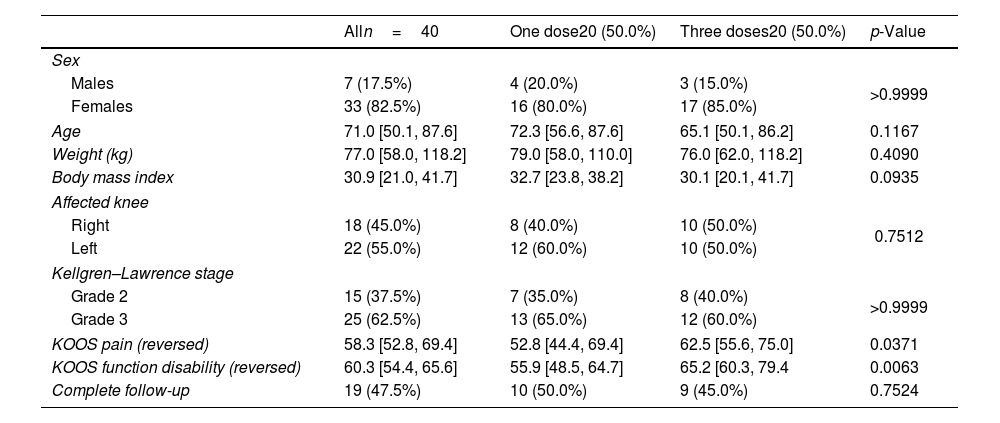
ResultsPatients descriptionA pilot study enrolled 40 KOA patients, split into two groups: one receiving a single SARC intra-articular injection, and another undergoing a three-dose regimen, with 20 participants in each group. Most patients were women aged 50–88 years (median age: 71) and were predominantly overweight or obese (median BMI: 31). KOA mainly affected grade 3 knees, with even right and left distributions. The single-dose group had older participants (median age: 72 vs. 65) and higher BMI (33 vs. 30) compared to the three-dose group. This group also reported higher baseline pain and disability levels (10- and 9-points median increase, respectively) compared to the one dose group. Over the six-month follow-up, 47.5% completed the study, 50% withdrew due to lack of efficacy, and 2.5% experienced a fatal event unrelated to the treatment (lung carcinoma). Withdrawals were classified as non-responders in the analysis (Table 1).
Baseline patients’ characteristics and follow-up completion of patients in the complete series (all), and those receiving a single (one dose) or three (three doses) SARC intra-articular injections. Continuous parameters are presented as medians with ranges (minimum to maximum values), and categorical variables are expressed as absolute frequencies and percentages. p-Values were derived from Mann–Whitney tests for continuous variables, and Fisher's tests for contingency tables for categorical variables.
| Alln=40 | One dose20 (50.0%) | Three doses20 (50.0%) | p-Value | |
|---|---|---|---|---|
| Sex | ||||
| Males | 7 (17.5%) | 4 (20.0%) | 3 (15.0%) | >0.9999 |
| Females | 33 (82.5%) | 16 (80.0%) | 17 (85.0%) | |
| Age | 71.0 [50.1, 87.6] | 72.3 [56.6, 87.6] | 65.1 [50.1, 86.2] | 0.1167 |
| Weight (kg) | 77.0 [58.0, 118.2] | 79.0 [58.0, 110.0] | 76.0 [62.0, 118.2] | 0.4090 |
| Body mass index | 30.9 [21.0, 41.7] | 32.7 [23.8, 38.2] | 30.1 [20.1, 41.7] | 0.0935 |
| Affected knee | ||||
| Right | 18 (45.0%) | 8 (40.0%) | 10 (50.0%) | 0.7512 |
| Left | 22 (55.0%) | 12 (60.0%) | 10 (50.0%) | |
| Kellgren–Lawrence stage | ||||
| Grade 2 | 15 (37.5%) | 7 (35.0%) | 8 (40.0%) | >0.9999 |
| Grade 3 | 25 (62.5%) | 13 (65.0%) | 12 (60.0%) | |
| KOOS pain (reversed) | 58.3 [52.8, 69.4] | 52.8 [44.4, 69.4] | 62.5 [55.6, 75.0] | 0.0371 |
| KOOS function disability (reversed) | 60.3 [54.4, 65.6] | 55.9 [48.5, 64.7] | 65.2 [60.3, 79.4 | 0.0063 |
| Complete follow-up | 19 (47.5%) | 10 (50.0%) | 9 (45.0%) | 0.7524 |
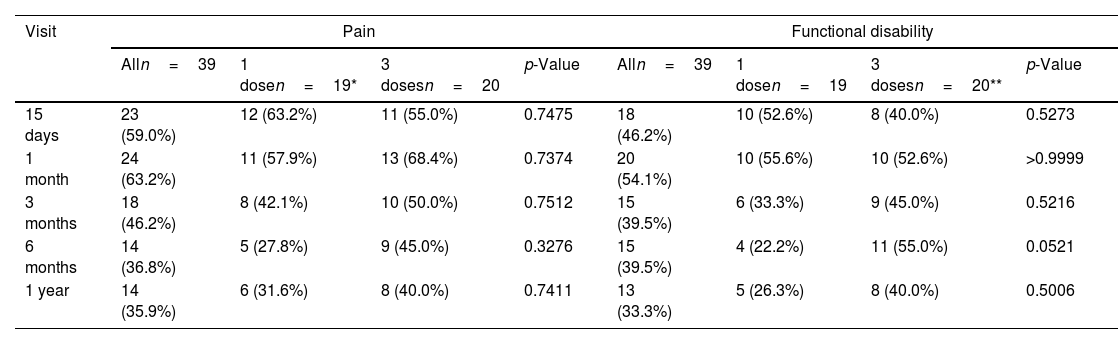
Overall, 59% of participants (23 patients) reported a 20% improvement in their pain levels after 15 days of treatment, as measured by their KOOS scores (Table 2). This proportion remained relatively consistent at the 1-month follow-up (63%, 24 patients), and gradually declined in subsequent assessments to 46% at 3 months (18 patients) and 37% at 6 months (14 patients). Interestingly, the rate of response at one year remained stable at 36% (14 patients), suggesting a sustained level of improvement comparable to that observed at 6 months (Table 2).
Rate of response to SARC intra-articular injections for 20% improvement over follow-up visits. The cells display the percentages of patients who achieved a 20% improvement in pain or functional disability, as indicated by their reversed KOOS scores. The data was recorded during follow-up visits at 15 days, one month, three months, six months, and one year after their treatment, and was compared to baseline scores (recruitment). Results are stratified by patients who received either a single or three doses. Withdrawals were treated as non-responders in all cases. Baseline data was missing for one patient from the single-dose group. p-Values show the statistical significance for the differences between the dosing regimens, and were derived from a Fisher's tests for contingency tables.
| Visit | Pain | Functional disability | ||||||
|---|---|---|---|---|---|---|---|---|
| Alln=39 | 1 dosen=19* | 3 dosesn=20 | p-Value | Alln=39 | 1 dosen=19 | 3 dosesn=20** | p-Value | |
| 15 days | 23 (59.0%) | 12 (63.2%) | 11 (55.0%) | 0.7475 | 18 (46.2%) | 10 (52.6%) | 8 (40.0%) | 0.5273 |
| 1 month | 24 (63.2%) | 11 (57.9%) | 13 (68.4%) | 0.7374 | 20 (54.1%) | 10 (55.6%) | 10 (52.6%) | >0.9999 |
| 3 months | 18 (46.2%) | 8 (42.1%) | 10 (50.0%) | 0.7512 | 15 (39.5%) | 6 (33.3%) | 9 (45.0%) | 0.5216 |
| 6 months | 14 (36.8%) | 5 (27.8%) | 9 (45.0%) | 0.3276 | 15 (39.5%) | 4 (22.2%) | 11 (55.0%) | 0.0521 |
| 1 year | 14 (35.9%) | 6 (31.6%) | 8 (40.0%) | 0.7411 | 13 (33.3%) | 5 (26.3%) | 8 (40.0%) | 0.5006 |
The single-dose group initially showed better response rates at 15 days (63%, 12 patients) compared to the three-dose group (55%, 11 patients). Over time, the response rate for the single-dose group declined more sharply, reaching 32% (6 patients) after one year. Meanwhile, the three-dose group peaked at one month (68%, 13 patients) and experienced a slower decline, maintaining a higher response rate of 40% (8 patients) at the one-year follow-up (Table 2).
Patients’ functional disability improvement followed trends like pain level responses. Initially, the single-dose group showed a higher response rate (53%, 10 patients) compared to the three-dose group (40%, 8 patients) at 15 days. By one month, the rates were nearly equal (one dose: 56%, 10 patients; three doses: 53%, 10 patients) but declined more sharply in the single-dose group over time. At the one-year follow-up, 40% of the three-dose group (8 patients) and 26% of the single-dose group (5 patients) sustained a 20% improvement in functional disability, though differences were not statistically significant (Table 2).
When analysed with more stringent criteria (50% improvement), the single-dose group demonstrated an 11% response rate (2 patients) in pain levels after one year of follow-up, while the three-dose group showed a higher response rate of 25% (5 patients). In terms of functional disability, these proportions were 21% (4 patients) for those treated with a single injection and 30% (6 patients) for the three-injection group (Supplementary Table S1).
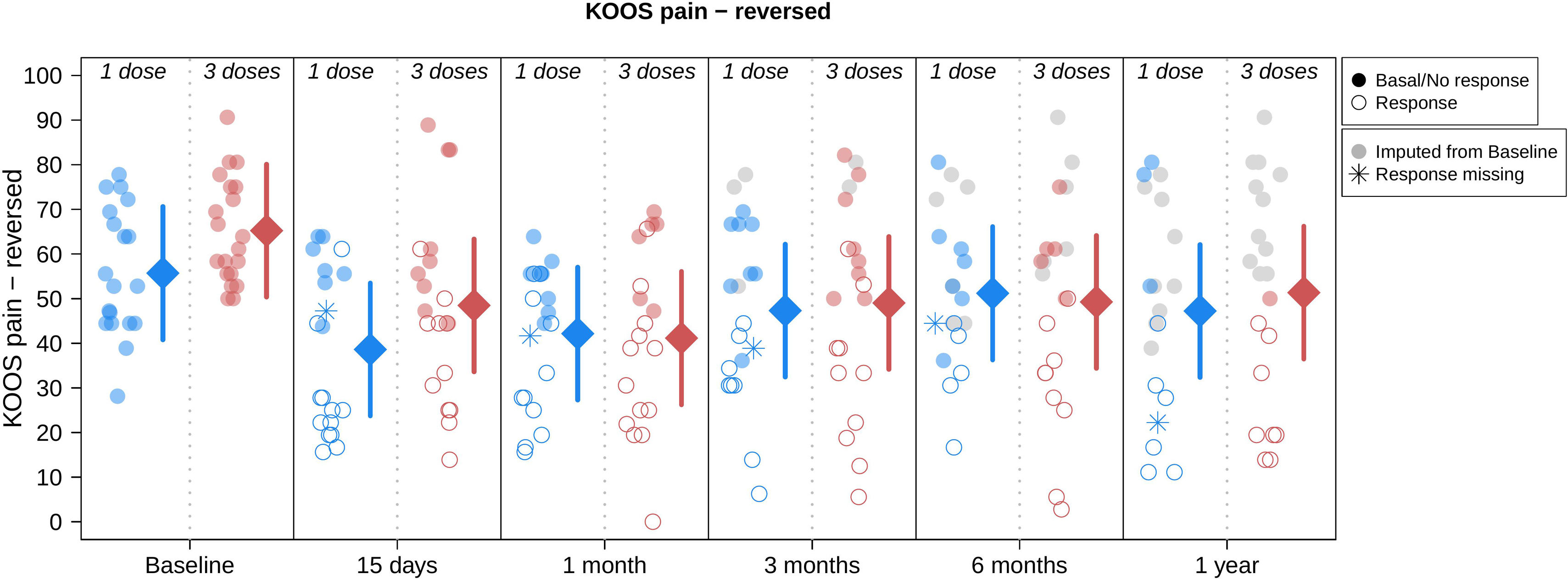
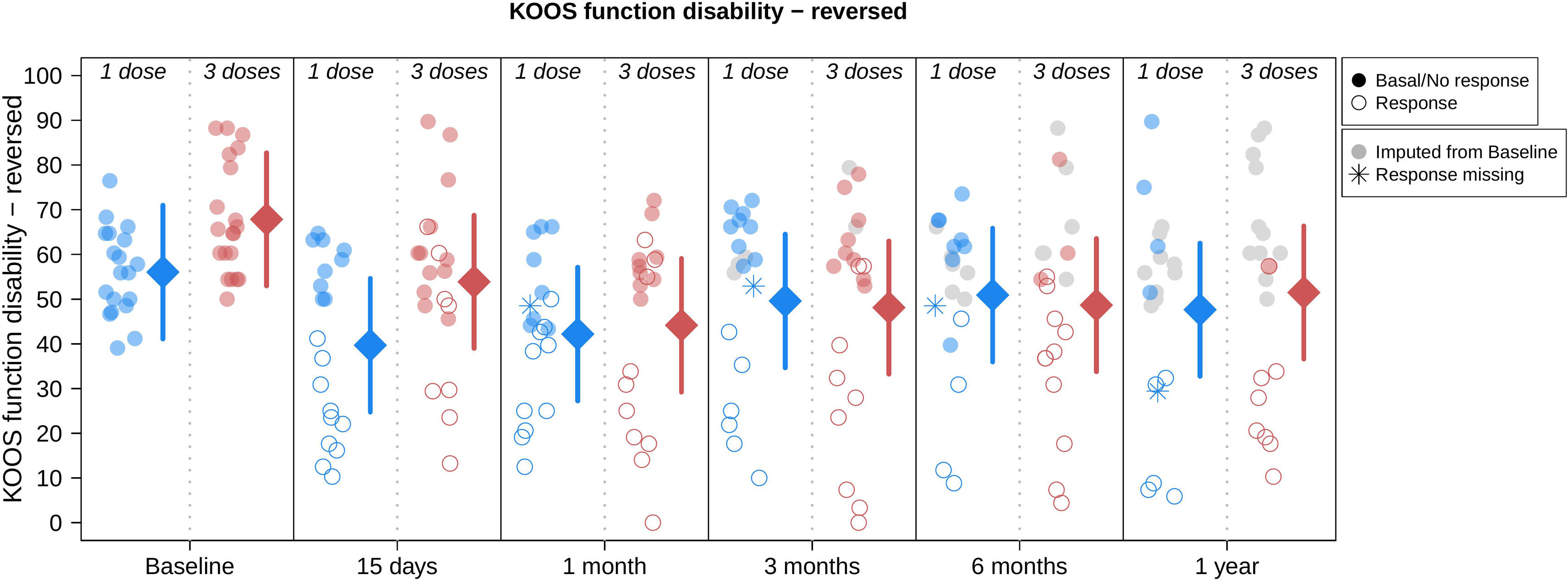
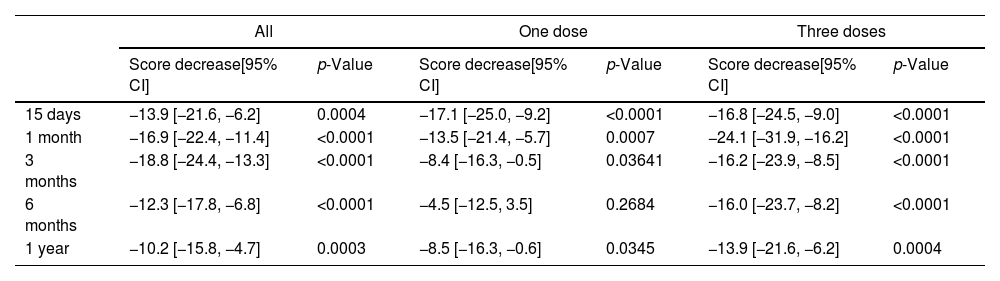
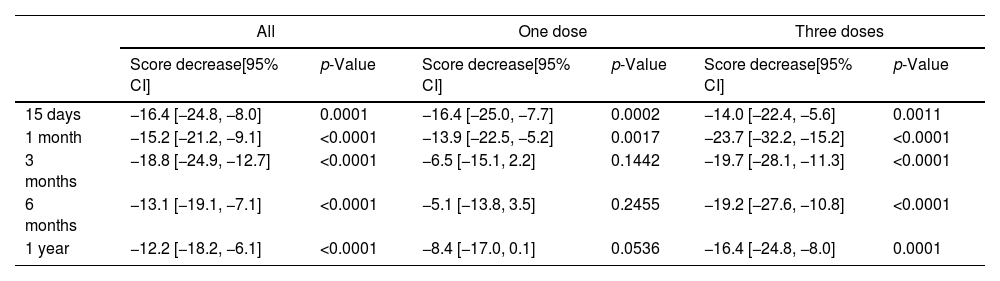
Quantitative analysis of KOOS score changesThe study conducted a quantitative analysis of reversed KOOS score changes over time (Figs. 1 and 2; Tables 3 and 4). Missing values were conservatively imputed from baseline scores to avoid overestimating treatment effects. Fifteen days after treatment, statistically significant decreases in pain and functional disability were observed which were comparable between the single-dose and three-dose groups (pain: 17.1 and 16.8 points decrease, p-values <0.0001; functional disability: 16.4 and p-value=0.0002, 14 points decrease and p-value=0.0011, respectively).

Pain perception at baseline and follow-up. The circle-shaped dots show the KOOS pain scores recorded at baseline and at 15 days, one month, three months, six months, and one year after treatment with SARC intra-articular injections. Empty dots indicate response to the treatment, defined as a 20% decrease in the score compared to baseline, while filled dots express basal values or lack of such response in the follow-up. Asterisk-shaped dots indicate values for a patient with missing baseline KOOS values and, hence, with response data not available. Gray dots in the follow-up visits are imputed values from baseline for patients who withdrew due to lack of perceived efficacy (20 patients). The diamond-shaped points and the adjacent segments display the adjusted group means of the scores and their corresponding 95% confidence intervals (95% CI), respectively. Adjusted means and 95% CI were derived from a mixed-effects linear model where time point, number of injections and their interaction were included as explanatory fixed effects, and patients were parametrized as a random effect.

Perception of function disability at baseline and follow-up. The circle-shaped dots show the KOOS function disability scores recorded at baseline and at 15 days, one month, three months, six months, and one year after treatment with SARC intra-articular injections. Empty dots indicate response to the treatment, defined as a 20% decrease in the score compared to baseline, while filled dots express basal values or lack of such response in the follow-up. Asterisk-shaped dots indicate values for a patient with missing baseline KOOS values and, hence, with response data not available. Gray dots in the follow-up visits are imputed values from baseline for patients who withdrew due to lack of perceived efficacy (20 patients). The diamond-shaped points and the adjacent segments display the adjusted group means of the scores and their corresponding 95% confidence intervals, respectively. Adjusted means and 95% CI were derived from a mixed-effects linear model where time point, number of injections and their interaction were included as explanatory fixed effects, and patients were parametrized as a random effect.
Pain improvement after SARC intra-articular injections. The cells display the decrease in pain perception according to the KOOS score at 15 days, one month, three months, six months, and one year after their treatment with SARC intra-articular injections. Results are stratified by patients who received either a single or three doses. p-Values express the statistical significance of the score decrease being different from zero, indicating a significant improvement in pain perception. p-Values and 95% confidence intervals (95% CI) were derived from a mixed-effects linear model where time point, number of injections and their interaction were included as explanatory fixed effects, and patients were parametrized as a random effect.
| All | One dose | Three doses | ||||
|---|---|---|---|---|---|---|
| Score decrease[95% CI] | p-Value | Score decrease[95% CI] | p-Value | Score decrease[95% CI] | p-Value | |
| 15 days | −13.9 [−21.6, −6.2] | 0.0004 | −17.1 [−25.0, −9.2] | <0.0001 | −16.8 [−24.5, −9.0] | <0.0001 |
| 1 month | −16.9 [−22.4, −11.4] | <0.0001 | −13.5 [−21.4, −5.7] | 0.0007 | −24.1 [−31.9, −16.2] | <0.0001 |
| 3 months | −18.8 [−24.4, −13.3] | <0.0001 | −8.4 [−16.3, −0.5] | 0.03641 | −16.2 [−23.9, −8.5] | <0.0001 |
| 6 months | −12.3 [−17.8, −6.8] | <0.0001 | −4.5 [−12.5, 3.5] | 0.2684 | −16.0 [−23.7, −8.2] | <0.0001 |
| 1 year | −10.2 [−15.8, −4.7] | 0.0003 | −8.5 [−16.3, −0.6] | 0.0345 | −13.9 [−21.6, −6.2] | 0.0004 |
95% CI: 95% confidence interval.
Improvement in function disability after SARC intra-articular injections. The cells display the decrease in perception of function disability according to the KOOS score at 15 days, one month, three months, six months, and one year after their treatment with SARC intra-articular injections. Results are stratified by patients who received either a single or three doses. p-Values express the statistical significance of the score decrease being different from zero, indicating a significant improvement in pain perception. p-Values and 95% confidence intervals (95% CI) were derived from a mixed-effects linear model where time point, number of injections and their interaction were included as explanatory fixed effects, and patients were parametrized as a random effect.
| All | One dose | Three doses | ||||
|---|---|---|---|---|---|---|
| Score decrease[95% CI] | p-Value | Score decrease[95% CI] | p-Value | Score decrease[95% CI] | p-Value | |
| 15 days | −16.4 [−24.8, −8.0] | 0.0001 | −16.4 [−25.0, −7.7] | 0.0002 | −14.0 [−22.4, −5.6] | 0.0011 |
| 1 month | −15.2 [−21.2, −9.1] | <0.0001 | −13.9 [−22.5, −5.2] | 0.0017 | −23.7 [−32.2, −15.2] | <0.0001 |
| 3 months | −18.8 [−24.9, −12.7] | <0.0001 | −6.5 [−15.1, 2.2] | 0.1442 | −19.7 [−28.1, −11.3] | <0.0001 |
| 6 months | −13.1 [−19.1, −7.1] | <0.0001 | −5.1 [−13.8, 3.5] | 0.2455 | −19.2 [−27.6, −10.8] | <0.0001 |
| 1 year | −12.2 [−18.2, −6.1] | <0.0001 | −8.4 [−17.0, 0.1] | 0.0536 | −16.4 [−24.8, −8.0] | 0.0001 |
95% CI: 95% confidence interval.
In subsequent assessments, patients treated with a single SARC intra-articular injection exhibited a decrease in their KOOS scores until their evaluation at 6 months of follow-up, where KOOS scores were no longer significantly different to those reported at baseline. After one year, pain levels and functional disability in these patients displayed decreases of 8.5 (p-value=0.0345) and 8.4 points (p-value=0.0536), respectively.
In contrast, patients treated with three injections continued to experience a decrease in KOOS scores at one month (pain: 24.1 points; functional disability: 23.7 points decrease; p-values <0.0001), increased at three months and stabilized at 6 months of follow-up, ultimately resulting in a final decrease of 13.9 (p-value=0.0004) and 16.4 points (p-value=0.0001) in pain and functional disability, respectively (see Supplementary Tables S2 and S3 for further details).
Adverse eventsThroughout the study period and follow-up, the research team did not detect any local or systemic adverse events related to SARC. Furthermore, no reactions after the intra-articular administration were reported. One death occurred in the single-dose arm due to a metastatic lung neoplasm, which was not related to the study treatment or procedures.
DiscussionIn this pilot study, we explored, for the first time, the feasibility of using Autologous Cytokine-Rich Serum (SARC) in patients with knee osteoarthritis (KOA) resistant to glucocorticoid intra-articular injections. The results are presented in a descriptive manner, recognizing the need for further confirmation through larger studies with a placebo-controlled design. Despite the preliminary nature of this investigation, several outcomes suggest the potential of SARC as a promising option for the treatment of KOA.
Firstly, we acknowledge that the number of patients achieving a KOOS 50% response is not as encouraging. However, it is noteworthy that approximately 30–40% of treated patients demonstrated a 20% improvement levels of pain and functional disability, which was considered clinically significant.24 Importantly, the patients included in our study were refractory to at least one glucocorticoid intra-articular injection within the last year. In addition, near all of them presented with a severe symptomatic disease, reflected by baseline KOOS scores exceeding 50 points in median for both pain and functional disability. Considering these characteristics in context, the observed rate of response can be seen an encouraging, even with relaxed criteria of 20% improvement. Moreover, the follow-up period comprised one-year which diminished the placebo effect.25
On the other hand, we assessed the results at one year of follow-up, in contrast to other studies on regenerative therapies that often focus on 3 or 6 months.26 In this sense, although we could not discard a placebo effect associated to an intra-articular injection, the evaluated response at one-year of follow-up in previously treated subjects with intra-articular injections partially mitigated the placebo response.27 This allowed to observe that responses at 3 months may serve as predictors of one-year efficacy, as patients achieving a positive response at this early stage tend to maintain good performance at one year, as it was previously described with other intra-articular treatments.28 Another noteworthy aspect is the absence of adverse events throughout both the application and the one-year follow-up period. Given that the population affected by KOA is typically elderly and exposed to high pharmacological consumption, the lack of adverse events and the suitability for intra-articular application make this approach favourable for administration in this population.29,30
While the recommended application for SARC involves three intra-articular injections, limited supporting information exists for this posology. In our study, we observed a higher rate of patient responses with the three-injection regimen compared to a single injection, although this difference did not reach statistical significance. However, the moderate improvement noted in the single-dose group, along with potential complications in administering a three-dose regimen and associated healthcare system costs, underscores the necessity for further investigation before establishing a definitive recommendation for this treatment approach. Additionally, patients in the single-dose group were older (72 vs. 65 years) and had a higher BMI (32.7 vs. 30.1) than those in the three-dose group, which limits the robustness of the conclusions.
Finally, the response results obtained in our study could be conditioned by the fact that all patients had been already treated with at least one intra-articular glucocorticoid injection in the last year. Administering SARC as the first treatment option might yield higher response rates, a point worth exploring in future studies.
The study highlights promising results for using SARC in KOA patients resistant to glucocorticoid injections. However, several limitations should be acknowledged. First, the study lacks a placebo or active control group, and has a relatively short follow-up of one year. Second, baseline differences in age and BMI between two groups, as well as the absence of data on osteoarthritis duration, may have limited the robustness of the comparisons. Additionally, the overall sample size, the small number of patients per group, and the high number of withdrawals further constrain the strength of the conclusions, although these patients were considered as non-responders for a conservative analysis. Future research should confirm outcomes through larger studies and focus on identifying biomarkers to enable patient stratification and personalized medicine in KOA treatments. Moreover, further studies including an active control group are essential to determine the true effect of SARC in KOA patients. Finally, the absence of adverse events and the need for further analysis of cost-benefits also underscore the study's preliminary findings.
ConclusionsThis pilot study offers promising, although preliminary, results for the use of Autologous Cytokine-Rich Serum (SARC) for KOA in patients with a symptomatic disease refractory to glucocorticoid intra-articular treatment. Our results also suggest that responses at 3 months may predict one-year efficacy, and the absence of adverse events supports the safety of SARC. These findings warrant further investigation in placebo-controlled trials with larger series of patients, including the evaluation of the cost-benefit of a three-dose regimen, and the identification of biomarkers of response to SARC therapy that pave the way toward personalized medicine in KOA management.
CRediT authorship contribution statementCO, AR, AB, AA, JC contributed to the conception and design of the study. CO, SG, JC contributed to the acquisition of data and patient visit and follow-up, and SARC administration. CA, RG, LU, AC contributed to the blood sample extraction, processing, storage, SARC processing and analysis performing. CO, SG, AR, AB and JC contributed to the analysis and interpretation of data. JC is the papers’ guarantor. All authors contributed to drafting the article or revising it critically for relevant intellectual content. All authors gave the final approval of the version to be submitted.
Consent for publicationAll authors have consented to the publication of this manuscript.
FundingThis research was supported by CERCA Programme/Generalitat de Catalunya.
Dr. Joan Calvet was awarded by an intensification Grant from I3PT in 2020 and 2022 and from Sociedad Española de Reumatología in 2021 and 2023.
Declaration of competing interestsAll the authors declare no conflicting interests related to the submitted work.
Data availabilityAll data and code used in this study is available from the corresponding author upon reasonable request.
We thank all the nurse team who help in performing blood extractions and accuracy of sample storage and conservation until its utilization. We greatly appreciate the support from the Research Unit in I3PT headed by Néstor Albiñana, especially Maria Nieves Gómez Gerique, who collaborated in the laboratory procedures. We also thank all the Rheumatology staff of Hospital Universitari Parc Taulí who referred candidate patients for recruitment and follow-up and actively collaborated in the functioning of the health assistance so that the authors could contribute to the confection of the study.
The following are the supplementary data to this article: